Oct 14, 2026Product Planning
How to Test Pool Robot Samples Before Ordering
Put a pool robot sample through what causes returns: steps, walls, fine sand, real runtime, parking and charger heat. The checks our R&D team would run.
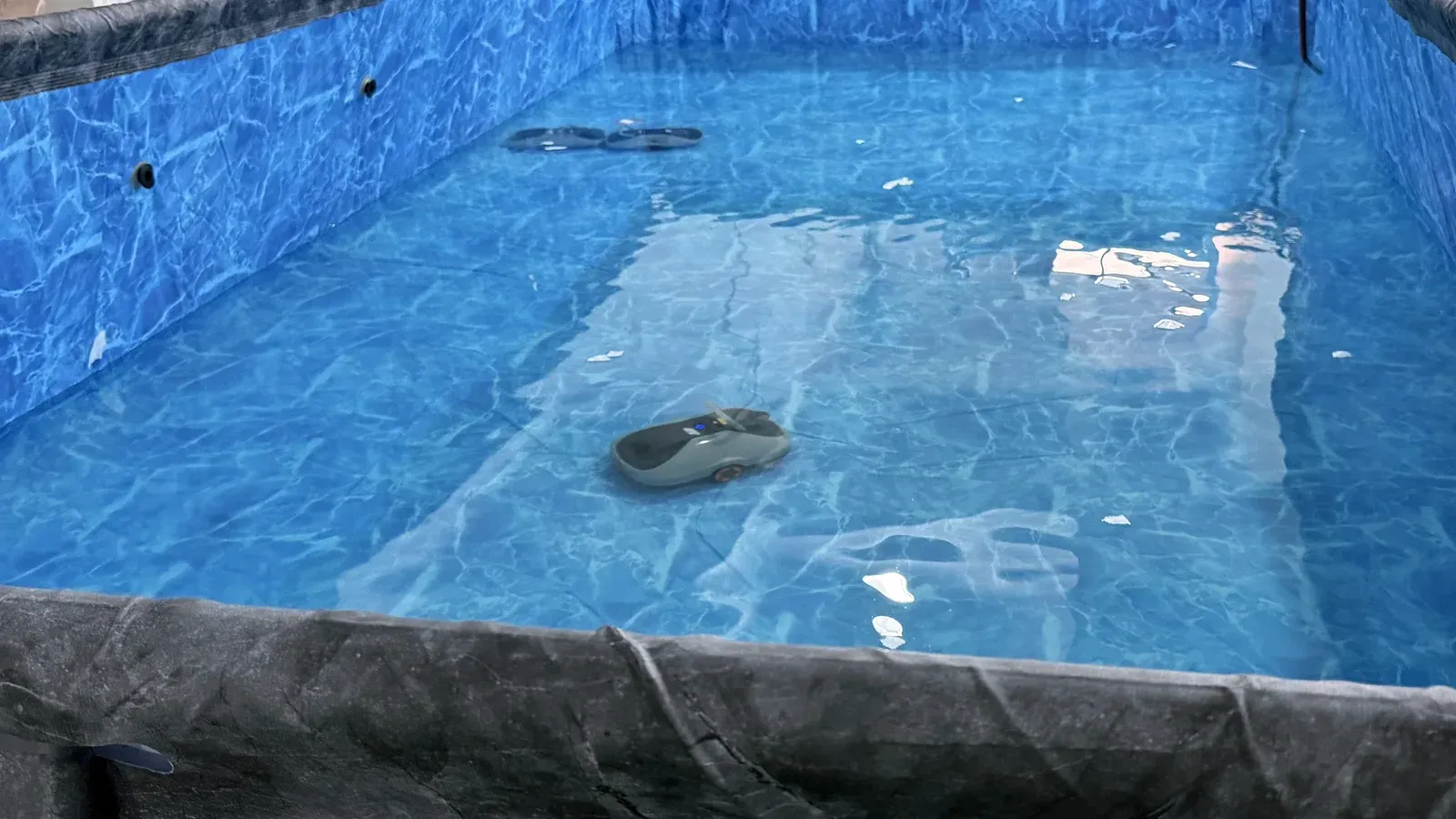
A pool robot sample usually gets a quick run in someone's pool, a nod, and then an order. The returns come later, from the situations nobody tried: the step it climbs onto and can't get off, the fine sand that goes straight through the filter, the battery that runs half as long as the box says.
Before mass production, our Y50S went through 20 validation tests and more than 70 checkpoints. You don't need a lab to repeat the parts that matter most to a retailer. This is the order we'd follow with any supplier's sample, ours included.
Does it get stuck on the steps?
Run the sample in a pool with steps, a main drain and a ladder, and on a vinyl liner if that's what your customers have. Let it finish three full cycles and write down every time someone has to rescue it. One rescue in three cycles is a warning sign. One rescue every cycle will turn into returns. Ask the supplier how the robot senses obstacles and what it does when it ends up on a step.
Does it actually climb the wall?
Check the spec sheet first. A floor-only robot isn't meant to climb, and plenty of "won't climb the wall" complaints come from owners who bought a floor-only model, so make sure the box says which surfaces it cleans. For a wall-climbing model, put a strip of tape at the waterline and watch whether it reaches it on the surface your market uses, whether that's tile, concrete or liner. Our Y50S has four cleaning modes covering the floor, walls and waterline. With any model, ask which surfaces it was tested on.
Does it pick up fine sand?
Sand is where a weak filter gives itself away. In our Y50S cleaning test we used a 3 × 3 m tiled pool, kept the water at around 10 °C, and put in 20 rotting leaves and 450 g of sand. After an hour the basket held 415 g, which is 92% against our 90% pass mark. You can run a smaller version: weigh a bag of play sand, spread it on the floor, run one cycle and weigh what ends up in the basket. Ask for the filter rating in microns too. Ours range from 180 µm baskets to the Y50, which adds a 10 µm fine filter.
How long does it really run?
Charge the sample fully and time one complete run from the moment it goes into the water. Do it twice if you can, once in warm water and once in the coldest water your customers swim in, because lithium batteries give less in the cold. Then compare the result with the number on the box. If the gap is large, your customers will find it before you do.
Does it come back to the edge?
Getting the robot out is a chore the owner does every time, and a robot that parks in the deep end is a robot that comes back. Check that it parks where the manual says it will when the battery runs low, then lift it out the way a customer would, with a full basket and water still inside. On the Y50S we hang three times the robot's weight on the retrieval hook and shake it for a minute. At the very least, the hook and handle should feel solid in your hand.
Does the charger run hot?
In March 2025, U.S. regulators recalled about 32,000 cordless pool robots because their charging adapters could overheat, so this check is worth ten minutes. Charge the sample indoors on a non-flammable surface and check the adapter every half hour, ideally with an infrared thermometer. During our Y50S validation the charger peaked at 41.6 °C over five hours of charging, against a 60 °C limit. While you're at it, ask for the UN38.3 report and the MSDS for the exact battery inside the sample.
What a sample can't tell you
One sample won't show you a seal that fails after a season, or what happens to the hundredth unit off the line. For those, ask about the tests on the design, such as our 1,100-hour life test on 10 Y50S units, and about what happens to every production unit. Every robot we build runs in a water tank before it's packed.
FAQ
How many samples should we test?
Two of the same model if you can. With two units you can tell a design problem from a one-off.
Can we test samples in our own market before ordering?
Yes. We confirm packaging, documents and the production order after you've tested samples in your own market.
Testing samples this season? Tell us which models you're looking at in the form below. We'll send the Y50S test summary and walk you through how we test.
Written by the Silver Home R&D and quality team.