Oct 14, 2026Buying Guide
Pool Robot Certification by Target Market
CE, RoHS, UKCA, FCC, SAA, KC and CB, plus UN38.3 for shipping: which marks each market expects on a pool robot, and why every certificate is per model.
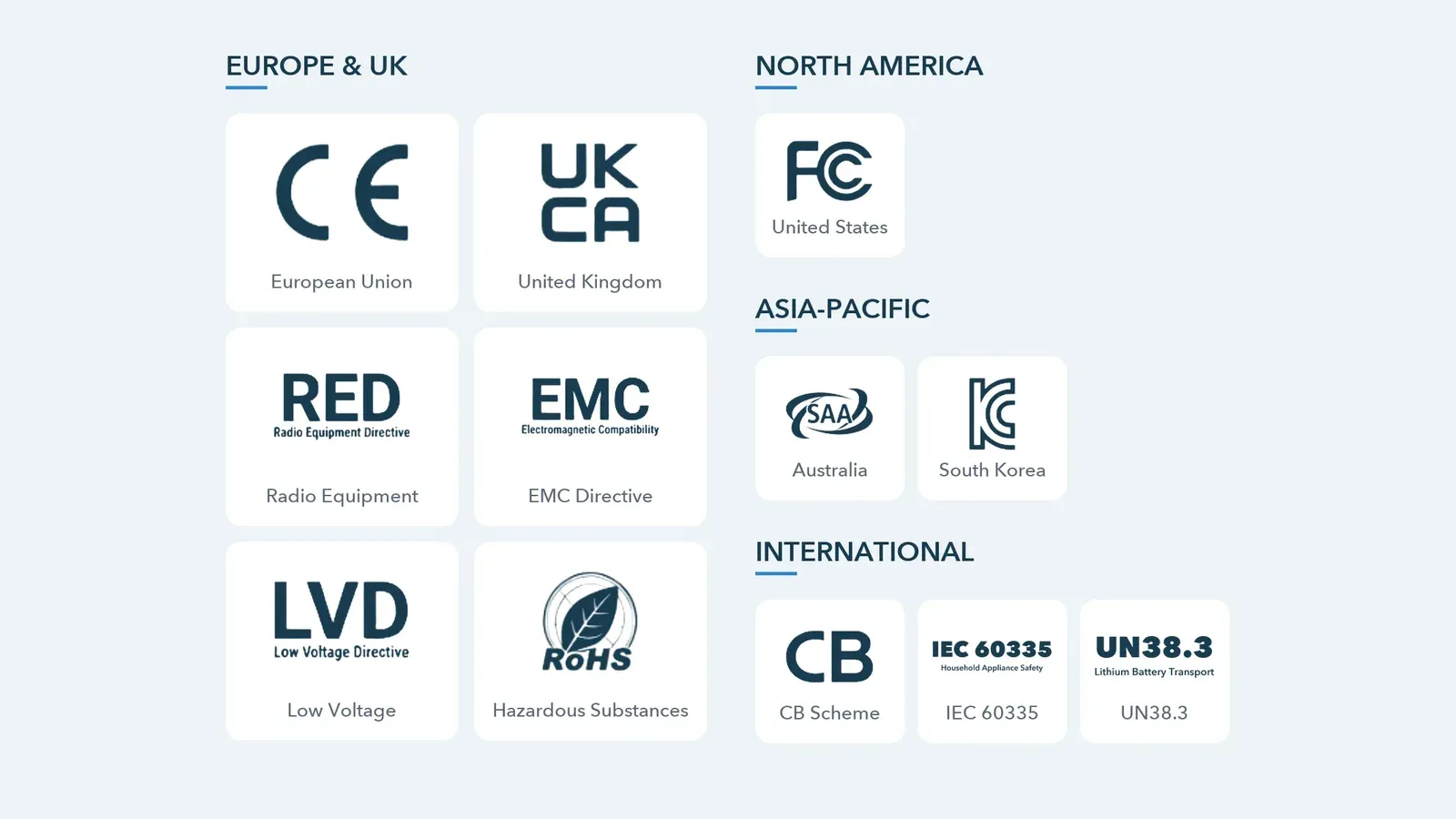
One of the first certification questions a new buyer asks us is “Do you have CE?” The honest answer is that it depends on the model. The more useful question is which marks your market expects for the exact model you're buying. A robotic pool cleaner combines a mains charger, a lithium battery, motors and, on many models, a radio for an app or remote. Each of those brings its own rules.
We're the R&D and quality team at Silver Home. Our range is certified for the markets importers sell in, and every certificate is issued per model. This is the market-by-market map we'd give a buyer before samples.
Which certifications do we need for Europe?
In the EU, a pool robot carries the CE mark. Behind it sit several sets of rules, depending on the design: electrical safety, electromagnetic compatibility and, for any model with an app or a remote, the Radio Equipment Directive. RoHS, which restricts hazardous substances in electrical and electronic products, sits under the same CE marking. Separately, recycling registration for the electronics and the battery usually falls on the company selling in each EU country, so plan it alongside the certificates.
Is CE enough for the UK?
Great Britain has its own mark, UKCA. The rules on whether CE alone is accepted there have changed more than once in recent years, so check the current position for your product with your compliance adviser before the box artwork is final. If you need UKCA, it's issued per model like everything else on this page.
What does the US require for a pool robot?
In the US, FCC rules cover electronic emissions, and any model with Wi-Fi, Bluetooth or another radio needs FCC authorization for that radio. The FCC statements then belong on the label and in the manual. On top of the federal rules, large retailers often have their own safety and testing requirements, so ask your buyer's compliance team for their checklist before you pick models. Choosing a model that already fits is far easier than testing one again later.
Australia, Korea and the CB scheme
Australian buyers usually ask for SAA approval for electrical safety, and the mains charger tends to get the closest attention. The local importer also carries its own legal responsibilities there, so bring your compliance contact in early. South Korea uses the KC mark for electrical safety and electromagnetic compatibility, with radio approval on top for models that have a radio. The CB scheme works as a bridge between markets: a CB test report and certificate to IEC standards can be accepted by national bodies in member countries as the basis for their own approval, which can save testing the same robot twice.
Why are certificates issued per model?
A certificate describes one design tested in one configuration. Change the motor, the battery, the radio module or the charger, and the old report may no longer cover it. The charger is the easy one to miss. A model sold in Europe, the UK, the US and Australia ships with a different plug for each, and sometimes a different charger version. A certificate for a sister model, or for the same robot with another charger, leaves a gap that a retailer's compliance team will find. That's why we answer certification questions by model: tell us the model and the market, and we'll send that model's document list.
Does a private-label brand need its own certificates?
If we were selling under our own brand, this is the question we'd ask first. In the EU, a company that places a product on the market under its own name or trademark generally takes on the manufacturer's obligations, including the declaration of conformity, the technical file and the details on the label. The factory's test reports usually form the base of that file, but the declaration has to name you. Other markets have their own rules on who counts as the responsible party, and some require that party to be based locally. Agree early who holds which document, and make sure the name on the rating label matches the paperwork.
What documents do we need to ship it?
Shipping has its own documents, separate from market marks. Lithium batteries need a UN38.3 test report, which covers the transport tests on the battery, and an MSDS, the safety data sheet your forwarder asks for before booking. Air freight adds dangerous-goods paperwork and labels. We supply both documents, and they have to match the exact battery in the robots you're shipping.
FAQ
Do all your models have CE?
Certificates are issued per model. Tell us the model and the market you sell in, and we'll send that model's document list.
Can we sell under our own brand using your certificates?
Our test reports are usually the starting point. In the EU, though, a company selling under its own brand takes on the manufacturer's role, so the declaration of conformity has to carry its name. Tell us the model and the market, and we'll go through which documents exist and which need to be issued in your name.
Selling a pool robot into a new market? Tell us the model and the country in the form below, and we'll send that model's certification and shipping document list. Our team will reply by email within 1 business day.
Written by the Silver Home R&D and quality team.