Oct 14, 2026Manufacturing
Pool Robot Packaging: Drop and Vibration Tests
A pool robot that arrives dead may have left the line working. What drop and vibration tests on packed robots show, what a fair pass is, and what to ask.
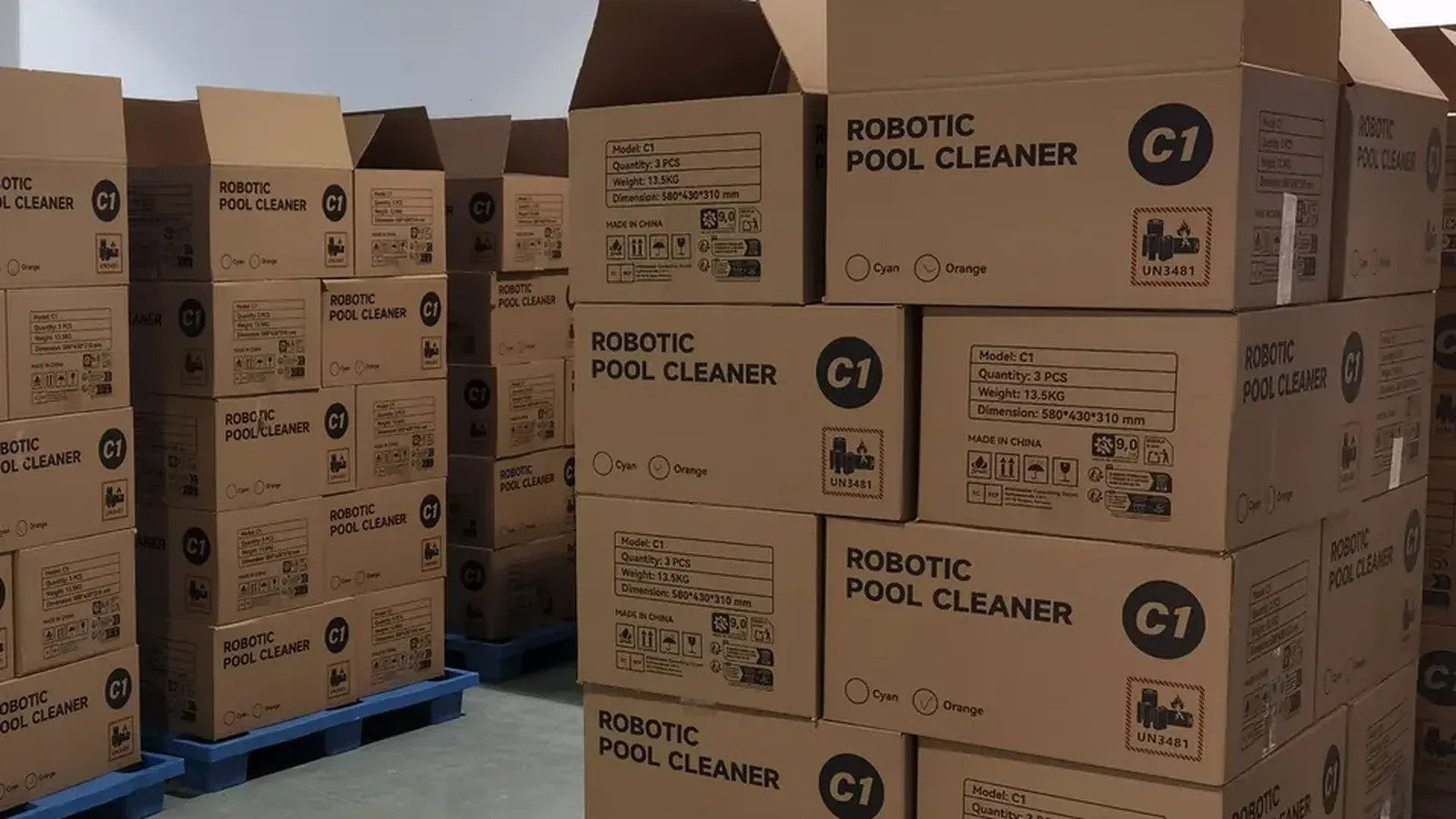
A robot that won't start out of the box gets logged as a faulty product. Sometimes it is. Sometimes the damage happened on the way: a connector shaken loose on a long truck ride, a bracket cracked when a carton landed on its corner, a seal nudged off its seat. The robot looks perfect, the box is a little scuffed, and the trouble only shows when it goes in the water.
That's why our Y50S was tested packed, the way it travels, as part of its validation before production.
What happens in a drop and vibration test?
Packed Y50S robots spent an hour on a vibration table, 20 minutes along each axis. That's the long, low-level shaking a carton gets on a truck or in a container. Then the cartons went through drop tests to GB/T 2423.7 and IEC 60068-2-31, the Chinese and international standards for the same rough-handling test, which covers the drops and topples a package takes when it's handled. Vibration loosens things slowly. A drop does it in one go. A packed robot has to come through both.
What counts as a pass?
Ask any supplier this, because a carton can come through looking fine while the robot inside doesn't. After our tests the color boxes were slightly dented. We accepted that, because the pass standard was about the robot: the units powered on, charged and cleaned normally afterward. A test that only inspects the outside of the box, or only checks that the robot switches on, can miss damage that won't show until the first time it goes in the water.
Why do pool robots arrive dead?
Every robot we build runs in a water tank and gets a final inspection before packing. If one arrives dead, the useful question is what happened between the packing table and the store. A pool robot carries its heaviest parts, the battery and motors, inside a sealed plastic shell. In a drop, those parts keep moving for a split second after the shell stops, and that's what stresses mounts and connectors. Good packaging slows that stop down, with inserts that hold the robot at its strongest points, a gap between the robot and the carton wall, and a retail box that sits snugly inside the export carton.
What should we ask about packaging tests?
Four questions cover most of it. Was the test run on the final retail box and inserts? Which standards were used, and was there a vibration test as well as drops? What was checked afterward, the box or the robot working in water? And will the test be repeated if the packaging changes?
That last question matters for private label. Your retail box is part of the program, along with your logo, a housing color and manuals in your languages. New artwork on the same box structure doesn't change how it protects the robot. A new box size, a different insert or extra accessories do, and that's the moment to ask for the packed unit to be tested again before mass production.
Is a container shipment the same as parcel delivery?
No. In a container, cartons travel stacked on pallets and get handled a few times along the way. A robot sold online often travels alone through a parcel network, where it's sorted, dropped and restacked many more times before it reaches a doorstep. Packaging that does well in a container can be too light for that. If your channel ships single units to end customers, tell your supplier early, and check whether your marketplace has its own packaging rules.
What can we check when the goods arrive?
Open a few cartons from different spots in the container, including the bottom of a stack and the end nearest the doors. Power each robot on, charge it and run it in water before the stock goes out to stores. If one fails, keep the carton and inserts and take photos before anything is thrown away. That's how you and your supplier can tell a packaging problem from a faulty unit.
FAQ
Is every carton drop-tested?
No. Drop and vibration tests run on sample cartons to validate the packaging design. Every production robot gets a water test and a final inspection before it's packed.
Does a dented box mean the robot is damaged?
Not necessarily. In our Y50S tests the boxes came out slightly dented and the robots worked normally. Run the robot in water before you decide.
Working out how your robots will travel? Tell us your channel in the form below, container to a warehouse or parcel to the end customer, and we'll share how the Y50S packaging was tested and what we'd check for your box. Our team will reply by email within 1 business day.
Written by the Silver Home R&D and quality team.