Oct 14, 2026Product Planning
Solar Pool Skimmer OEM: 7 Things to Check
Adding a solar skimmer to your pool line? Check the panel, basket, docking, chlorine dispenser, radio approvals and battery papers before you order.
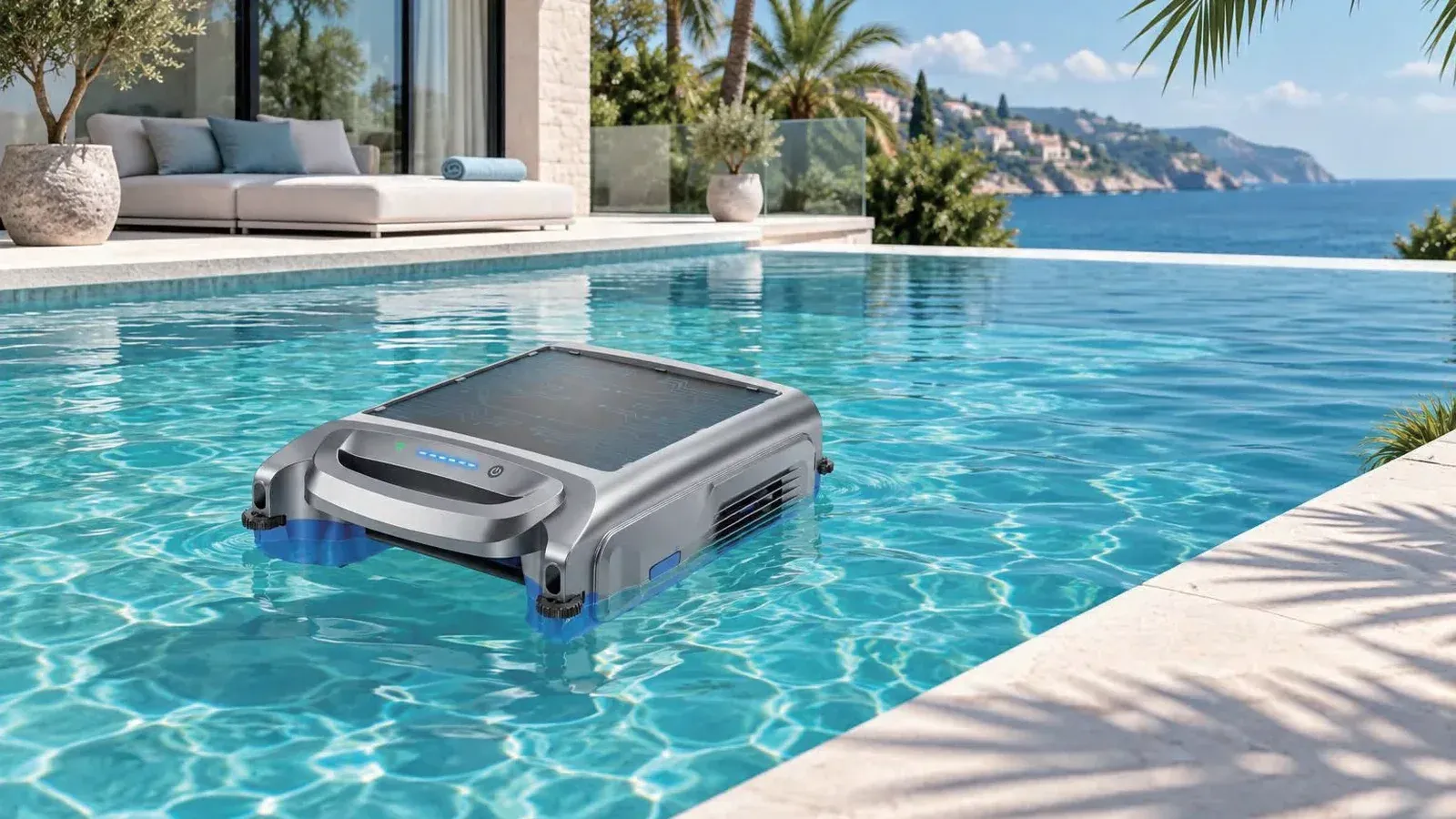
Pool owners notice the surface first. Leaves, petals and insects float for a while before they sink, and once they're on the floor they become the floor robot's job. A solar skimmer catches them while they're still on top, which is the whole case for adding one to a pool line.
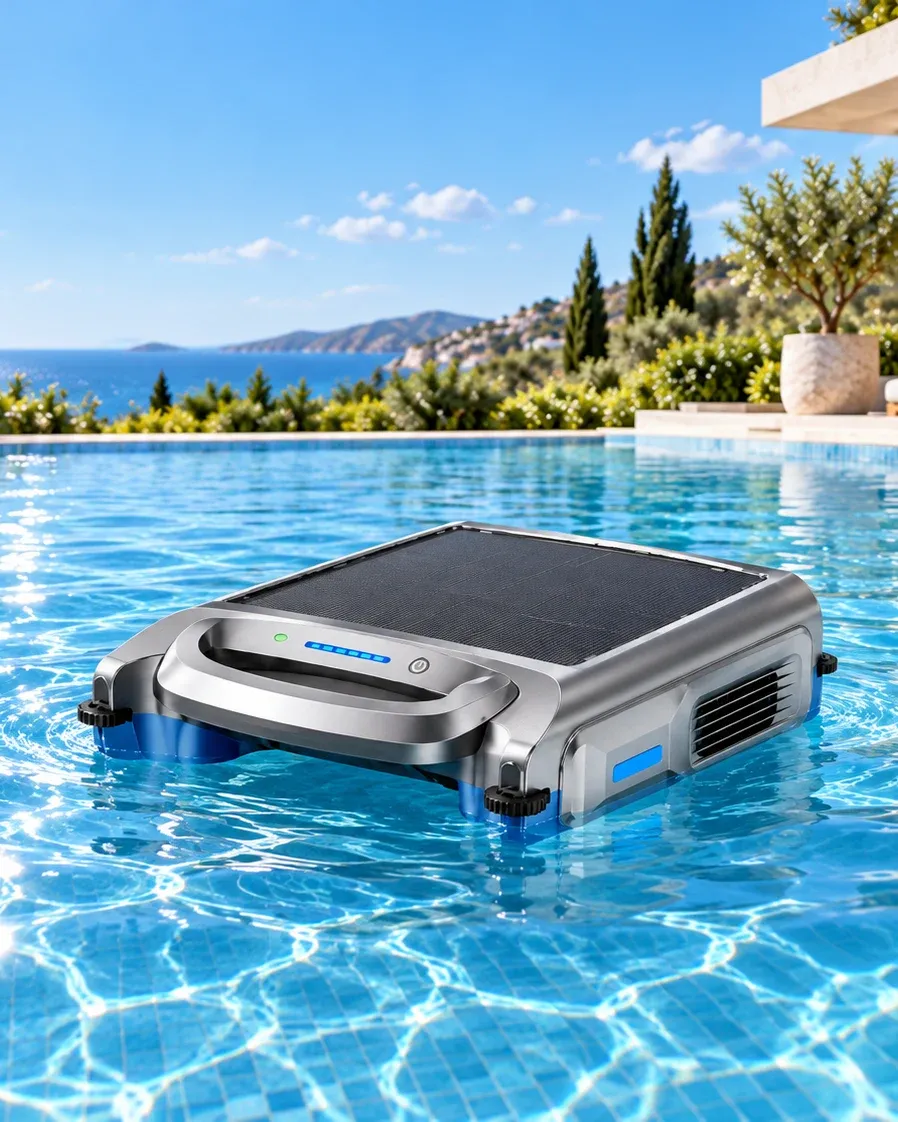
We build two of them, the S100 and the Y90 Pro, and we've written this from the R&D side: the seven things we'd check if we were putting our own logo on a solar skimmer. You can verify most of them with one sample and a few direct questions.
1. Panel size and real runtime
Start with the panel. Our S100 carries a 20 W panel and runs up to 25 hours on a charge, while the Y90 Pro has a 10 W panel and runs up to 17 hours. Treat any runtime figure as a best case, ours included, because it depends on how much sun the pool gets. That's why both of ours also charge from an adapter. When you compare quotes, ask for the panel wattage and the battery capacity side by side, and ask what the owner does in a cloudy week.
2. Basket size versus your customers' trees
Basket size decides how often the owner has to lift the skimmer out. The S100 has an 8 L basket and the Y90 Pro a 3.5 L one, and both filter down to 180 µm. If your customers have big trees around their pools, the larger basket is worth paying for. If they mostly deal with dust and insects, the smaller one does the job.
3. How it avoids walls and comes back
A skimmer that bumps along the wall all afternoon looks broken to the person who bought it. The S100 uses two time-of-flight (ToF) distance sensors to steer away from walls and covers pools up to about 200 m². The Y90 Pro parks at the pool edge when it's done, so it's easy to lift out. When your sample arrives, run it in a pool with steps and corners, not only in a plain rectangle.
4. Chlorine dispenser and tablet size
Both of our skimmers have a dual-action chlorine tablet dispenser, and the S100 takes 3-inch tablets. Check that the tablet size matches what your customers already buy in your market. A dispenser that needs an unusual tablet turns into a support call.
5. App control and radio approvals
The S100 has app control for cleaning modes, steering and battery level, and the Y90 Pro works with an app or a remote. Anything with a radio needs the right approvals for where you sell it: CE under the Radio Equipment Directive in the EU, FCC in the US. Ask for the documents for the exact model you're buying, and ask whether the radio module carries its own FCC ID. Certificates are issued per model, so a file for a sister model won't satisfy a retailer's compliance team.
6. Battery shipping documents
Solar skimmers ship with lithium batteries, so your forwarder will ask for a UN38.3 test report and an MSDS before booking, and air freight adds dangerous-goods paperwork and battery labels. We supply both documents. Whoever you buy from, get them before you place the order, not when the goods are already packed.
7. What you can change, and how long it takes
On an existing model, private label usually covers your logo, a housing color from the available range, your packaging and the manual language. Private-label minimums run from 500 to 2,000 units depending on the model, and a first program takes about 90 days, with repeat orders in 30–45 days. If you'd rather test the market first, neutral stock starts at 100–300 units and ships in 7–14 days. Either way, test samples in your own market before you sign off on packaging.
The last check is the simplest one. Leave the sample in a pool for a week and see whether it's still skimming, still charging and still where you expect it each evening. A week in a real pool tells you more than a spec sheet does.
FAQ
Do solar skimmers work on cloudy days?
They run on the battery, and the panel recharges it whenever there's light. Both of ours can also charge from an adapter.
Does a skimmer replace a pool robot?
No. A skimmer clears the surface and a floor robot cleans the floor and walls. Because the skimmer removes debris before it sinks, there's less left for the floor robot to do.
What's the MOQ for a private-label solar skimmer?
Private label starts at 500–2,000 units and neutral stock at 100–300 units. We confirm the exact quantity by model.
Adding a solar skimmer to your line? Tell us your market and target price in the form below, and we'll send specs, options and a quotation for the S100 and Y90 Pro.
Written by the Silver Home R&D team.