Oct 27, 2026Planificación de gama
Aspiradoras de mano: el filtro pesa más que la autonomía
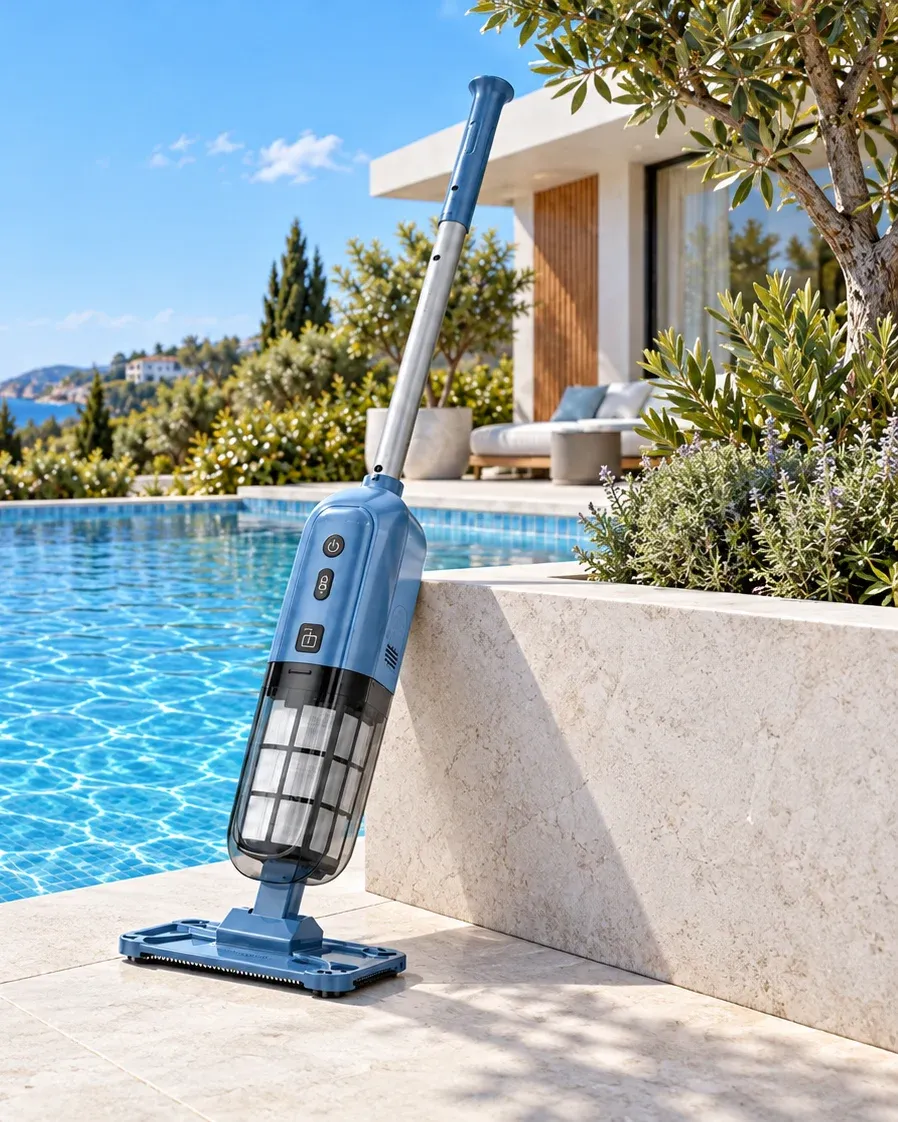
El H100 funciona 60 minutos y el H200, 120, ambos con 68 L/min. La etapa de filtración de 5 µm del H200, más que la hora adicional, es el motivo para incorporarlo a su gama.
Our H100 and H200 handheld pool vacuums move the same 68 L/min, and the H200 runs 120 minutes to the H100's 60. Stock the H200 for its 5 µm filter stage; the extra hour is a bonus.
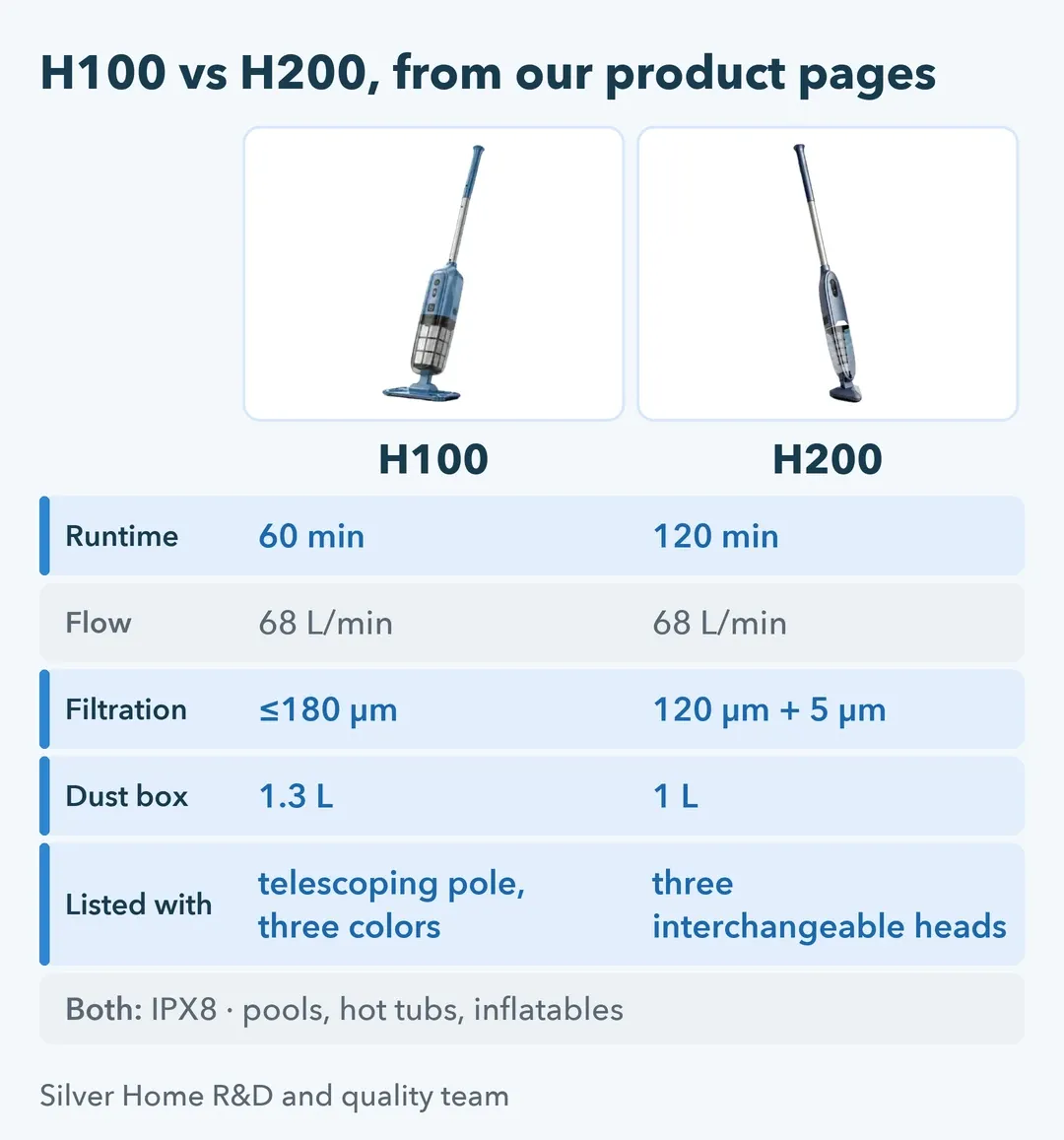
Same suction on paper
Both are cordless, IPX8 and listed for in-ground and above-ground pools, hot tubs and inflatable pools. The flow figure is identical, so staff shouldn't sell one as stronger than the other. The differences are runtime, filtration and the dust box, plus what each listing shows: the H100 with a telescoping pole and three colors, the H200 with three interchangeable heads for floors, corners and narrow gaps.
Which one picks up spa silt?
The H200. It filters in two stages, a 120 µm mesh and then a 5 µm fine filter, where the H100 uses a single filter rated ≤180 µm. Spas and hot tubs collect fine sediment that a coarse mesh lets straight back into the water. The trade-off is capacity: the H200 has a 1 L dust box against the H100's 1.3 L, and a fine stage loads up sooner, so in a leafy pool the owner empties it more.
Does anyone need 120 minutes?
Owners of small pools who don't own a robot do. The H200 is listed for a whole pool on one charge, which suits someone cleaning the floor by hand today. An owner who already has a floor robot wants a handheld for the steps, the hot tub and the corners the robot misses; steps and benches are where floor robots struggle, and owners say so in reviews. For that job the H100's 60 minutes is plenty.
Where owners already have a robot and the pools are leafy, skip the H200: its 1 L dust box fills sooner.

Three complaints a spec sheet won't show
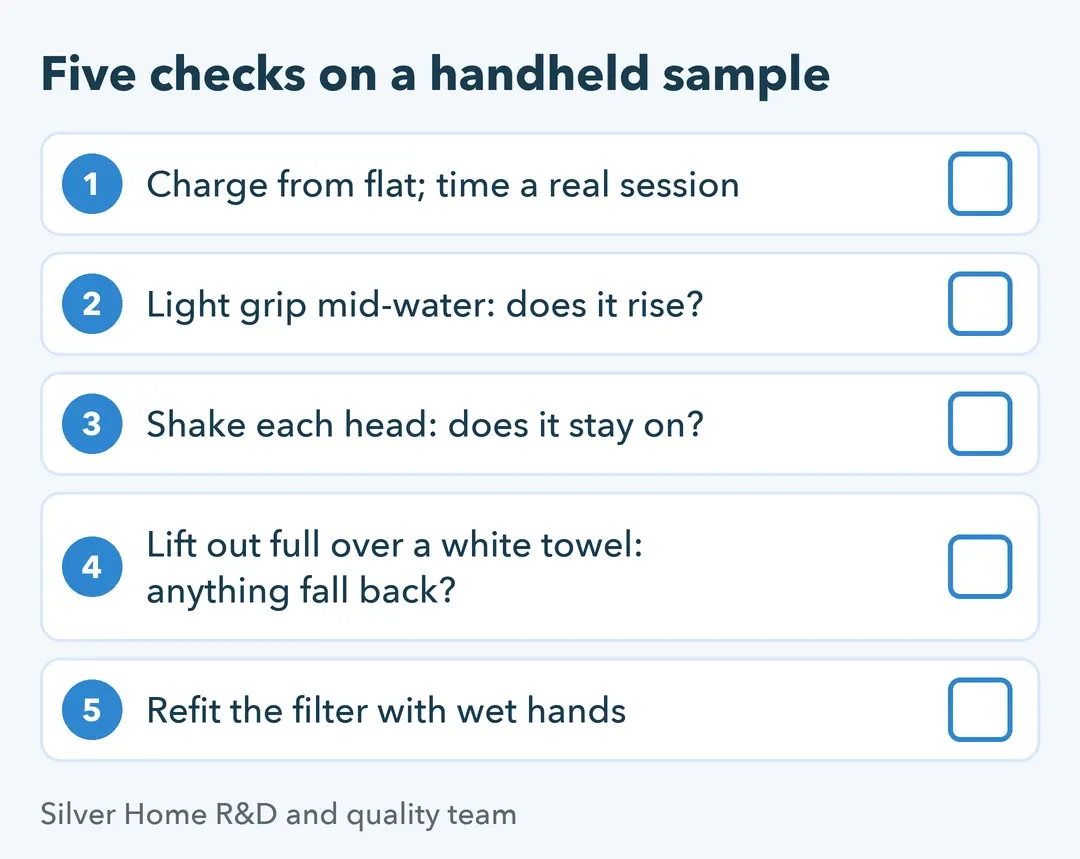
Review sites carry three complaints about handheld pool vacuums: units light enough to drift up mid-pool, heads that come loose and drop dirt back in, and batteries that stop charging after a few months. Test for them on samples. Charge each one from flat and time a real session on the pool steps. Hold it mid-water with a light grip and watch whether it rises. Shake each H200 head, lift each unit out over a white towel with a full dust box, then refit the filter with wet hands.
The battery complaint needs one more question. An owner forum's repair summary for one handheld blamed a cheap charger for the dead batteries, so ask which charger ships with the H100 and H200 samples and charge them with that one only. Batteries and chargers for both models can be ordered separately; keep a few at your service desk before the pool season starts.
Built and water-tested in Changzhou
Both handhelds are built in our own factory in Changzhou, and every unit is water-tested before packing, the same as our robots.
That run shows each unit works underwater before it ships. It can't tell you whether your customers will find the H200's 1 L dust box too small; your sample session can.
Order one H100 and one H200 as samples, run the five checks in a hot tub and in a pool, and split your first order by what you see.
Written by the Silver Home R&D and quality team.