Oct 24, 2026Buying Guide
Buying Pool Robots From China: A Season Plan
Plan a China pool robot order back from the shelf date: 6 milestones with owners, and when a 90-day first private-label run won't fit the season.
Buying a robotic pool cleaner from China for next season starts with one date: the day units must be on the shelf, ready to sell. Work backward from it. Using our published program windows as the example, a first private-label order needs about 90 days to goods-ready, before freight. If that doesn't fit in front of your shelf date, sell neutral stock this season and launch your own label the next.
That's the whole decision. The rest of this guide is how to make it with dates instead of hope.
Start at the shelf, not at the factory
Write the shelf date as stock that's received, cleared and allowed on sale, with the packaging and manual your channel has approved. From there, step back through store delivery, warehouse receiving, customs clearance and freight until you reach the day the goods must leave the factory. That's your factory handover date, and it's the only date a supplier can actually commit to.
Our lead times end at goods-ready and exclude sea and air freight. Take transit and customs allowances from your forwarder for your actual route, not from a previous order or a website.
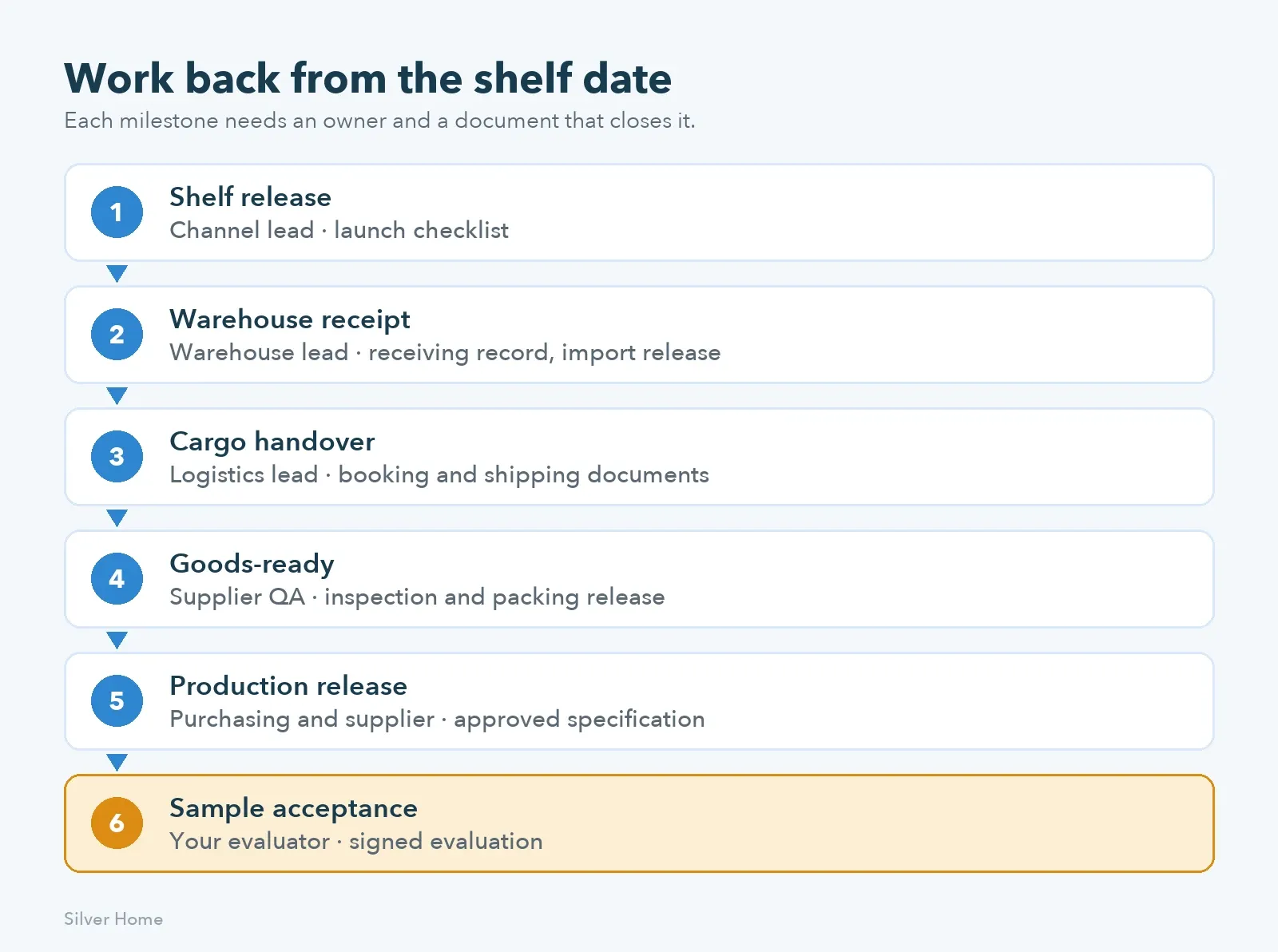
Six milestones, each with an owner and a closing document
Shelf release closes when the stock is cleared for sale. The owner is your channel or retail operations lead, and the closing document is a launch checklist: received, approved sales materials in place, clear to sell. A vessel arrival date doesn't close it.
Warehouse receipt closes against the receiving record and import release. Your warehouse lead owns it, working with whoever handles customs. Agree how carton labelling mistakes get fixed before stock becomes available, because that's where days disappear.
Cargo handover closes when the forwarder has the shipping documents it needs and collects the goods. Your logistics lead owns it. Ask for two deadlines, one for documents and one for physical collection; record both dates, even if the forwarder confirms they coincide.
Goods-ready closes with inspection and packing released. The supplier's production and quality leads own it. At this point every unit should have passed its production checks, with any inspection findings closed on paper.
Production release closes against an agreed order specification: model, approved housing color, packaging and manual revision. Your purchasing lead and the supplier's project lead own it together. Ask which event starts the quoted lead time, so no task gets counted twice.
Sample acceptance closes with a signed evaluation. Your technical evaluator owns it, and the supplier's engineer closes any findings. Test in the pools your customers actually have, then freeze the cleaning claims you plan to print.
When does an OEM pool cleaner order fit the season?
Take a 500-unit first private-label order, inside our published range of 500–2,000 units. Our published first-program window is about 90 days to goods-ready, and packaging artwork, color and manual approvals account for most of the difference from a 30–45-day repeat order. Ask the supplier which of your open tasks sit inside that window and which must finish before it starts. If the confirmed goods-ready date lands before your handover date, with freight, customs and receiving outside it, the order fits. Book it.
Now change one thing. Same order, same model, but the local pool test hasn't happened and the manual claims are still open, and the supplier's confirmed goods-ready date lands after your latest handover date. Don't treat it as a repeat order to borrow the 30–45-day window. Repeat timing belongs to repeat orders.
If the confirmed date misses the handover, sell neutral stock or move the branded launch.
When should you switch to neutral stock?
Switch when your own brand can't be ready but the shelf can't stay empty. In our published program, neutral stock runs 100–300 units with 7–14 days to goods-ready. That's a different order, unbranded and smaller, so confirm the model and availability and rerun the freight and customs calculation before you count on it.
If your channel insists on branded cartons at launch, neutral stock won't solve it. Then the real choice is between moving the shelf date and cutting the launch scope. Either way, keep the private-label sample and artwork moving on their own dates, so next season doesn't start late too.
Three risks that break the schedule
Late artwork changes are the first. The gap between about 90 days for a first program and 30–45 days for a repeat is mainly packaging artwork, color and manual approvals. Once approved, any change to the artwork, color or instructions should come back with a written answer on the goods-ready date.
A sample re-test is the second. If the robot leaves debris in a corner, record the surface, the debris and the conditions before anyone changes anything, and agree what result closes the issue. Don't let the packaging move to print while the sample is still being argued over.
Battery documents are the third. Each battery model needs its UN38.3 test report and safety data sheet, and air freight adds dangerous-goods paperwork and labels. If you plan to fly spare batteries in the same carton as the robots, IATA's 2026 rules require them to ship at a state of charge of 30% or less when each battery is rated above 2.7 Wh. Tell the factory when you place the order.
How do published lead times compare across suppliers?
Two of the suppliers in our manufacturer comparison publish timing on their websites, checked October 25, 2026. Hysheen's private-label page says buyers receive within 30–45 days for its existing-model program. Facilo's FAQ gives a 15–60-day lead time. Our published windows end at goods-ready: 7–14 days for neutral stock, about 90 days for a first private-label program and 30–45 days for repeats.
Those numbers can't be lined up as they are. Copy each supplier's exact wording into your sheet, then add four fields: start event, approvals included, end point, and transport excluded. Compare only once all four are filled.
A one-page plan to send your supplier
Put the plan on one page and send it with your order request. List the shelf date, the factory handover date you worked back to, the model and quantity, and the approvals still open: sample, artwork, housing color, manual. Add the shipping mode, whether spare batteries travel with the robots, and who signs each approval on your side.
Ask the supplier to reply on the same page with three things: the goods-ready date it can commit to, the event that starts its clock, and any approval it needs from you by a fixed date. Treat the reply as incomplete until it states the goods-ready date, the clock-start event and the deadlines for any outstanding approvals.
Check it again every time an approval slips.
How we handle this at our Changzhou factory
At our Changzhou factory, every production robot runs in a water tank before packing and every unit gets a final inspection; both sit inside the goods-ready window. We supply UN38.3 test reports and MSDS for lithium battery shipping, and spare parts and batteries can be ordered separately with the first run.
If your shelf date is less than one first-program window plus freight away, don't start a private-label program with us this season. Start with neutral stock, or plan the branded launch for the next one.
Silver Home designs and builds robotic pool cleaners in its own factory in Changzhou. Send your shelf date, target models and market through the form below, and we'll confirm quantity and timing by model.
Prepared for the Silver Home website.