Oct 24, 2026News & Insights
Fluidra and Aiper: What It Means for Buyers
Fluidra paid $100 million for 27% of Aiper, citing robotic adoption below 25% of 30 million pools. Three signals for retailers and private-label buyers.
When a listed pool equipment group pays US$100 million for a minority stake in a Chinese cordless robot brand, the pool robot market has changed shape. Fluidra announced the investment for 27% of Aiper on April 1, 2025, and completed it on December 23, 2025. For retailers and private-label buyers, the deal says more about where the category is heading than any market report.
Everything below comes from Fluidra's two press releases, plus one comparison with a public listing filing. We don't add numbers that aren't in those documents.
What did Fluidra buy into Aiper, and on what terms?
Fluidra agreed to take a 27% interest in Aiper for $100 million, paid through new Aiper shares. The announcement set out a second phase: Fluidra plans to move to a majority stake through a later investment once Aiper's revenue passes $370 million with EBITDA margins near 15%. The completion release in December 2025 confirms the first 27% closed and that the second phase depends on those targets.
In the same announcement, Fluidra put Aiper's 2024 sales at about $195 million.
Why did Fluidra buy into a cordless robot brand?
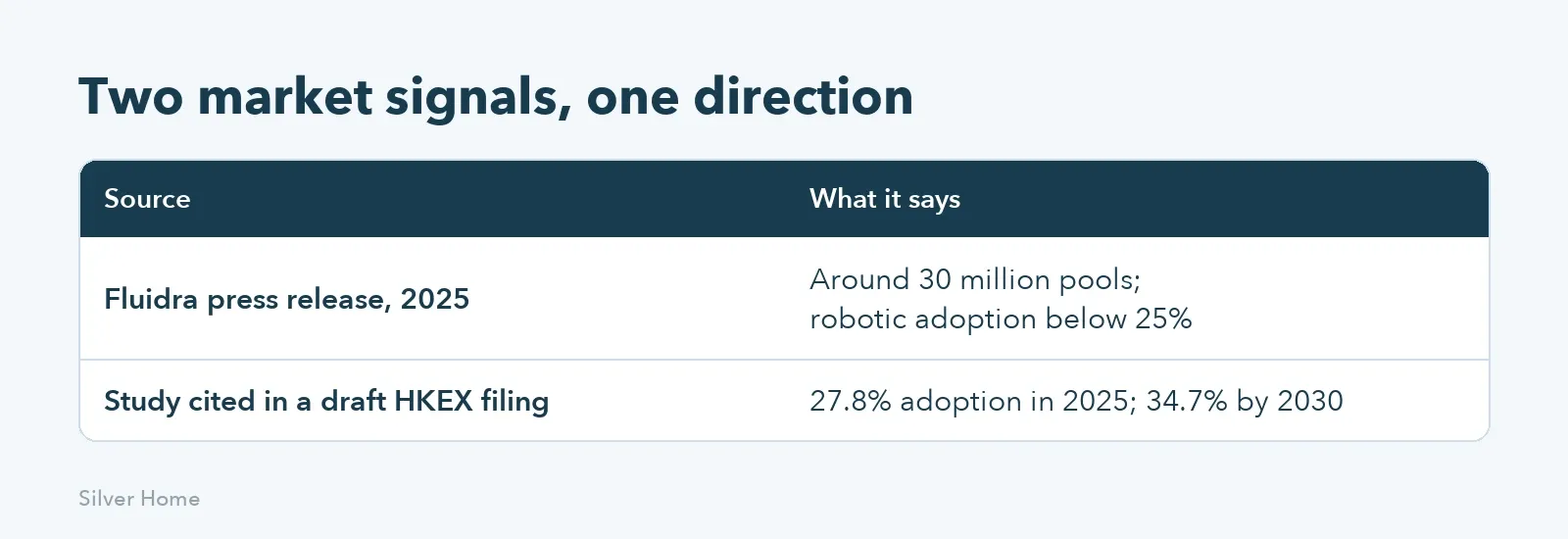
Fluidra gave its own reason in numbers: around 30 million pools worldwide, with robotic cleaner adoption still below 25%. A group that already sells pool equipment through professional dealers is betting that the remaining three-quarters of pools will move toward robots, and that cordless models will lead that move.
A different source points the same way. A draft listing document filed with the Hong Kong stock exchange in April 2026 by a Tianjin pool robot maker, marked incomplete and subject to change, cites a commissioned study that puts robotic cleaner adoption at 27.8% of pools in 2025 and 34.7% by 2030. The two estimates don't match exactly, which is normal for market data, but they agree on direction.
Three signals for retailers and private-label buyers
First, the professional channel is opening to cordless robots from Chinese brands. When a group with a dealer network owns part of a brand, that brand reaches pool shops and distributors more easily. Expect cordless robots to compete harder for the same shelf space you're planning for.
Second, these two cases show investment going into branded businesses, and in one filing a deliberate cut in ODM volume. The same Hong Kong filing shows its author shrinking ODM sales from 203.0 thousand to 130.7 thousand units between 2023 and 2025 while its own brands grew. If your plan depends on a factory's spare ODM capacity, confirm that capacity in writing.
Third, the bar for evidence will rise. A brand backed by a listed equipment group will be expected to meet that group's quality and compliance standards. Private-label ranges sold next to it will be judged on the same questions: battery safety, sealing, spare parts and after-sales support.
Big money in a category doesn't make every launch safe.
What the second-phase targets tell you
The majority-stake trigger is revenue above $370 million, set against 2024 sales of about $195 million. That's close to double. The thresholds describe the scale needed for the next investment, not a timetable.
For a retailer, the useful move is to watch what actually happens: distribution announcements, new models, promotions. Adjust your own range calendar when those appear, not on the strength of a deal term.
Questions to put to your supplier after the deal
Ask whether the factory makes robots for any brand that now has an equipment-group shareholder, and whether that affects capacity in your season. You may not get names, and you don't need them; you need the capacity answer in writing.
Ask how the supplier will keep your model's spare parts available for the life of the range if its biggest customers change. A shareholder change at a brand can move volume between factories quickly.
Ask which of your model's documents are model-specific: test reports, certificate files, battery shipping papers. A buyer competing with a backed brand needs every one of them on file before the first retail review.
Does a private-label range still make sense next to backed brands?
Yes, when the range has a clear role. Retailers use private label to own a price point, protect margin and control the assortment. A backed brand doesn't remove that need; it raises the standard the private label has to meet. Build the range on evidence you can show a buyer, and on a factory whose capacity commitment you can read.
It makes less sense if you're competing on features alone. Matching a well-funded brand's app and navigation roadmap is expensive. Compete on fit, price, documents and service.
How we test this at our Changzhou factory
Silver Home has been backed by Lenovo since 2020. At our Changzhou factory, capacity is 200,000 pool units a year. Private-label programs run from 500 to 2,000 units per model, with about 90 days for a first program and 30–45 days for repeat orders, and the factory holds ISO 9001, ISO 14001 and ISO 45001 certificates issued by CQC.
Silver Home designs and builds robotic pool cleaners in its own factory in Changzhou. If you're planning a private-label range alongside branded cordless robots, send your target models, quantity and market through the form below, and we'll confirm quantity and timing by model.
Prepared for the Silver Home website.