Oct 24, 2026Manufacturing
Pool Robot Test Reports Compared: Y50S Example
Read pool robot test reports line by line: Y50S cleaning 92% vs a 90% pass mark, cell 40 °C vs a 67 °C limit, and what a pass can't tell you.
The word "pass" is the least useful line in any pool robot test report. Our Y50S cleaning test recorded 92% sand collection against a 90% pass mark: a pass, by 2 points. What a buyer needs is the gap between each result and its limit, and the conditions behind both. Compare those, and two suppliers' reports start to line up.
Everything below comes from the Y50S validation report, run from November 2024 to January 2025: 20 tests, 75 checkpoints, each with a written pass standard, signed by the tester and a reviewer. All 20 passed. These results belong to Y50S and to no other model.
How to read any test line
Read every line in the same order: what was tested, under what conditions, on how many samples, against what limit, with what result, and who signed it. If one of those six fields is missing, the line can't be compared with anyone else's yet. Ask for the missing field before you put the result in a specification.
Then mark each line one of three ways: comparable, different setup, or missing evidence. That turns a stack of reports into a short list of decisions: accept the comparable lines, arrange a shared test for the different ones, and request what's missing before the sample is approved.
Cleaning: 92% against a 90% pass mark
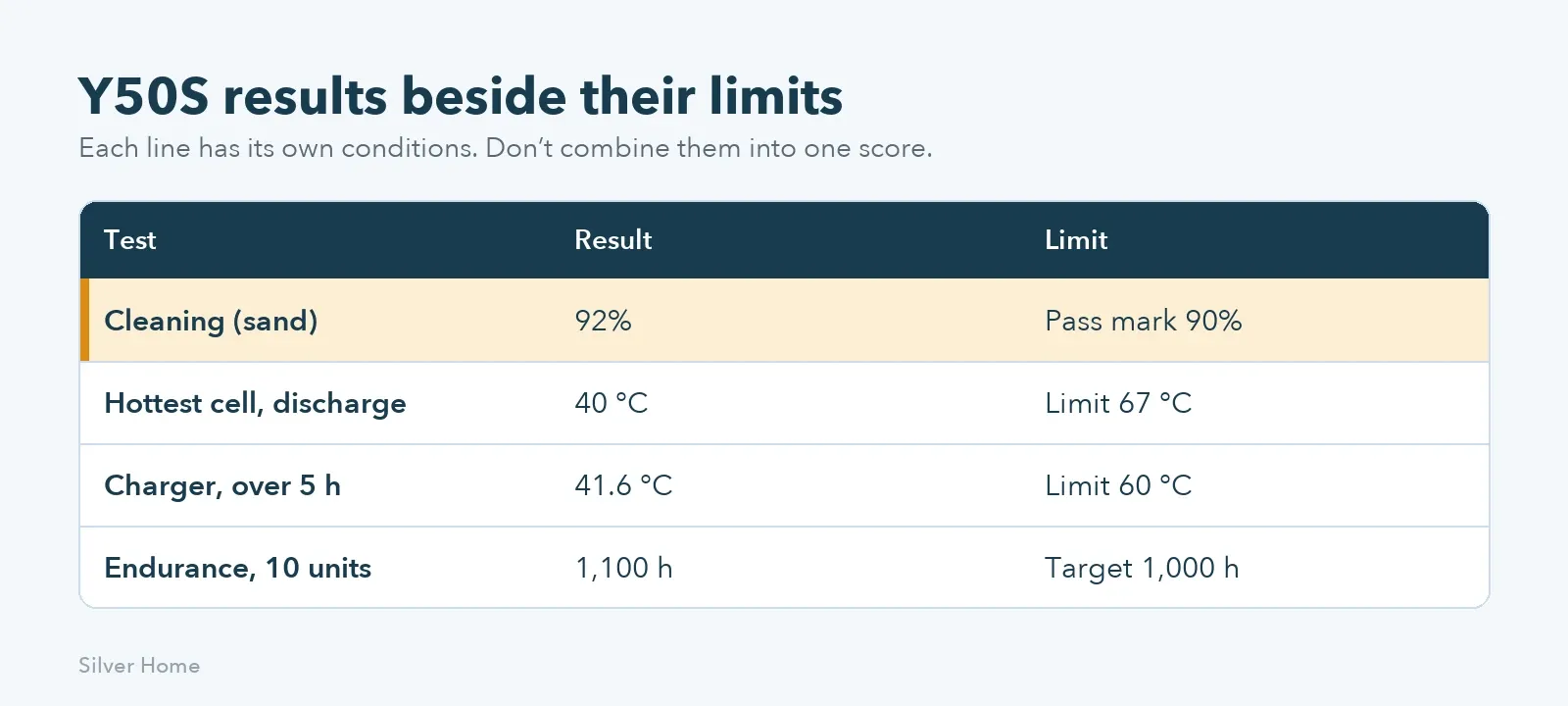
We tested Y50S in a 3 × 3 m tiled pool, water around 10 °C, with 20 rotting leaves and 450 g of sand. After 1 hour every leaf was gone and the filter basket held 415 g of sand, recorded as 92%. The pass mark was 90%.
The result was 2 percentage points above this test's pass mark, and it's the line we'd re-test first in your own pool. A tiled test pool isn't a pebble finish or a vinyl liner, and cold water isn't midsummer. If your customers' pools differ, run your own sample test on their surfaces before you print a cleaning claim on the box.
When another supplier quotes a cleaning percentage, ask for the debris, the surface, the water temperature and the run time. Without them, two percentages don't belong in the same column.
Battery and charger: why these lines matter most
Temperature lines deserve the closest reading, because the energy path is where recent field problems have shown up. In April 2026 the U.S. Consumer Product Safety Commission announced a recall of about 5,000 cordless robotic pool vacuums whose lithium-ion batteries could overheat, with ten reports of overheating or fire while charging and while not charging.
On Y50S, the hottest battery cell reached 40 °C during discharge against a 67 °C limit. The charger peaked at 41.6 °C across more than 5 hours of logged charging, against a 60 °C limit, and passed a 3.6 kV withstand test. The firmware shuts the robot down on over-temperature and locks it out at low voltage.
Keep the cell and the charger on separate lines; they're different parts under different conditions. For any other report, ask where the sensor sat, what the ambient temperature was and how many samples were logged.
Endurance: 1,100 hours, with honest wear
Ten Y50S units ran for 1,100 hours against a 1,000-hour target, on a DC supply, cycling 3 hours on and 1 hour off. There were no motor stalls, no track slip and no software faults, and every unit was still running at the end. The tracks showed real wear.
Keep the wear note next to the pass.
This pool robot lifespan test says something about motors, drive and firmware over long running time. Because it ran on a DC supply, it says nothing about battery cycle life, and its hours shouldn't be turned into years of residential use. Ask for battery-specific evidence separately.
Tests where the result is an observation
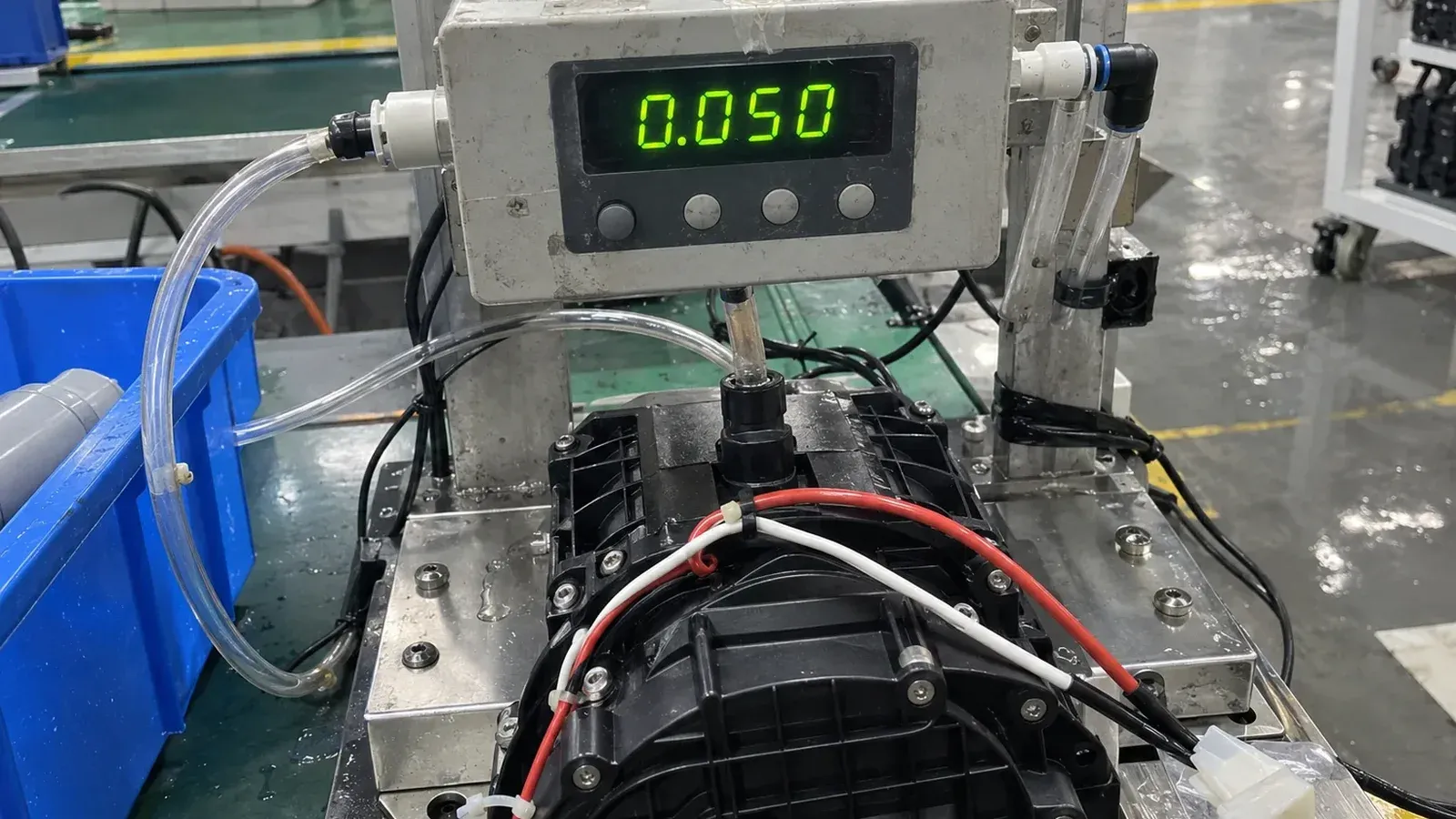
Some lines have no number to compare, and they still matter. The motor housing was pressurized to 0.05 MPa, held, then submerged to look for bubbles; none of the 3 samples leaked. Packed robots spent 1 hour on a vibration table, 20 minutes per axis, and were drop-tested to GB/T 2423.7 and IEC 60068-2-31; the boxes dented slightly and the robots inside powered on, charged and cleaned normally.
Control boards ran 8 hours at 70 °C and 90–95% humidity, 8 hours at -20 °C, and 10 hot-cold shock cycles. Tracks and seals cycled between 70 °C and -20 °C for a week, and every plastic, silicone and rubber part soaked in bleach and algaecide solution for a month without cracking, fading, peeling or changing shape. The power button took 1,000 presses at a minimum of 15 N, and the retrieval hook held 3 times the robot's weight while being shaken for a minute.
For lines like these, compare the stress applied and what was observed afterward. Ask for the hold time, the drop height and the solution concentration if you plan to repeat them.
Validation is not the batch you receive
A validation report describes defined tests on samples. It doesn't describe the units being packed for your order. That's what production records are for, and a robotic pool cleaner factory should be able to show them for your batch: the water test, the final inspection and the cosmetic checks.
Ask one more question: if a component or the firmware changes after validation, which tests get repeated? Get the answer before you approve the order.
How we test this at our Changzhou factory
At our Changzhou factory, every production robot runs in a water tank before packing and every unit gets a final inspection. Cosmetic checks hold part gaps and steps under 0.3 mm and match colors against approved samples. Those are production checks, kept separate from the Y50S validation program.
Signs of a thin test report, and what to ask for
A result with no limit beside it. A pass with no sample count. A cleaning percentage with no pool surface or debris load. A temperature with no sensor position. A report that names a product family instead of a model, or one that nobody signed. Any of these means the report can't be compared with another one yet.
None of them proves the product is weak. They prove the paperwork is incomplete, and that's the gap to close before you approve a sample.
Ask every supplier for the same four things: the validation summary for the exact model you'd order, the pass standard for each test line, the production water-test procedure, and a sample production record. Ask once, in writing, in the same words to everyone. The replies will tell you which robotic pool cleaner factory keeps records and which one keeps promises.
This report doesn't cover battery cycle life, other models, or your customers' pool surfaces. It leaves some procedure details, such as hold times and solution concentrations, in the full record rather than the summary. Don't fill those gaps with assumptions; ask for them, and note which ones matter for the claims you plan to print on the box.
Silver Home designs and builds robotic pool cleaners in its own factory in Changzhou. If you're planning a sample evaluation, request the Y50S validation test summary through the form below and tell us which test line you want to compare.
Prepared for the Silver Home website.