Oct 24, 2026News & Insights
Robot-Vacuum Makers Are Moving Into Pools
Roborock, Ecovacs and Dreame have all announced pool robots since 2025. What carries over from floor robots, what doesn't, and what retailers should check.
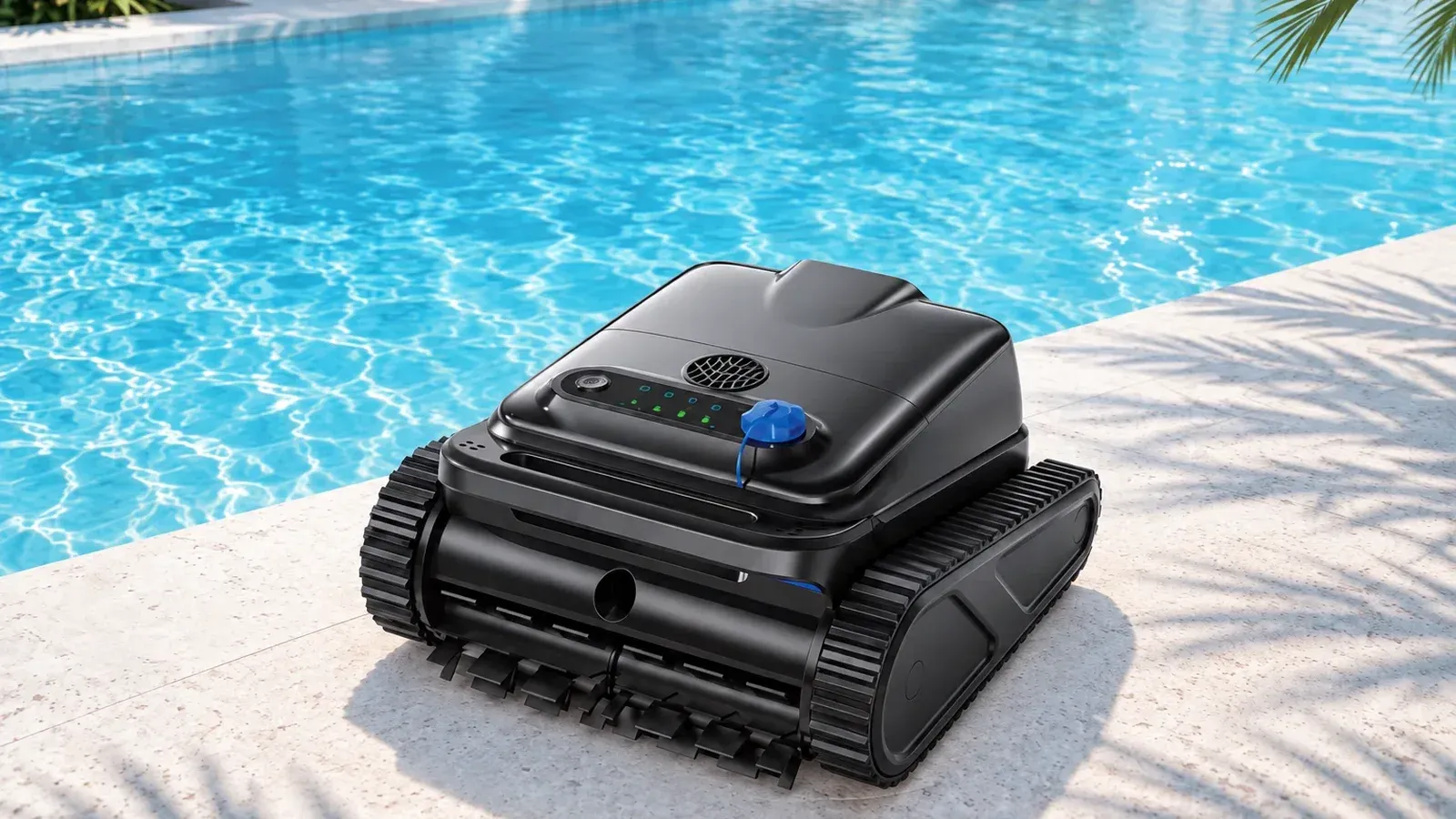
The biggest names in floor-cleaning robots have announced pool robots, on different rollout dates, and that changes the shelf, not the physics. Dreame launched its Z1 Pro robotic pool cleaner at CES 2025 and put it on sale in the U.S. from March 1, 2025. Ecovacs unveiled its ULTRAMARINE pool cleaner at CES 2026. Roborock showed its first pool cleaner, the RockAqua P1, at IFA 2026, with Australia and New Zealand named as first markets from January 2027.
For a retailer or importer, the useful question isn't who's arriving. It's which robot-vacuum skills survive underwater, and which have to be proven again from scratch.
Why are robot vacuum makers building pool cleaners?
The overlap in parts and know-how is real. A cordless pool robot uses brushless motors, a lithium battery pack, a battery management system, an app and a navigation algorithm. Robot-vacuum makers already buy those parts in volume, already run app platforms, and already have retail relationships in the markets where private pools are common.
The market is also large enough to justify the move. A draft listing document filed with the Hong Kong stock exchange in April 2026 by a Tianjin pool robot maker, marked incomplete and subject to change, cites a commissioned industry study that puts global robotic pool cleaner GMV at US$2,799.7 million in 2025. Pool equipment group Fluidra has said robotic cleaner adoption is still below 25% of the roughly 30 million pools worldwide. The two estimates differ, but both describe a category with room to grow.
What carries over from floor robots, and what doesn't?
Judge the underwater parts on underwater evidence.
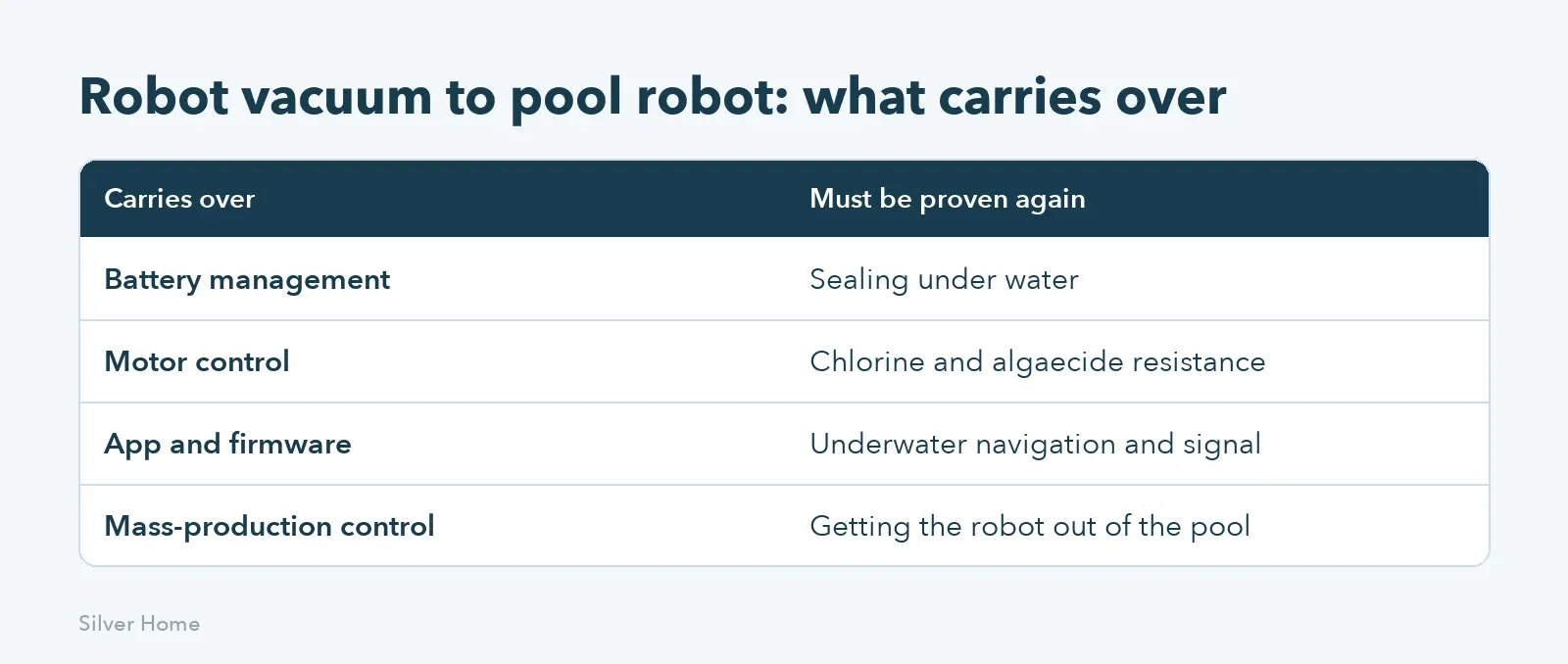
Battery management, motor control, app design and mass-production discipline carry over well. So does the experience of running a consumer support operation for connected devices.
Three things don't carry over. The first is sealing. A floor robot meets spills; a pool robot spends its working life fully submerged, then sits in the sun. Motor housings, battery compartments and charging ports have to stay dry under pressure, run after run.
The second is chemistry. Pool water carries chlorine and sometimes algaecide or salt. Tracks, brushes, seals and housings have to keep their shape and grip after months of exposure. A floor robot never faces that test.
The third is navigation and communication. Radio signals fade quickly in water, and lidar designed for living rooms doesn't map a pool wall. Underwater robots rely on other sensors and on surfacing or docking to talk to an app. That's why pool robot navigation is its own engineering problem, even for a company with years of floor mapping behind it.
What do new entrants change for retailers?
More well-known brands on the shelf raise shopper awareness of robotic pool cleaners in general. They also raise the bar for packaging, app quality and after-sales response, because shoppers compare a pool robot with the robot vacuum they already own.
For a private-label range, that means the spec sheet alone won't hold a price point. You'll need clear evidence on the things a big brand also has to prove: sealing, chemical resistance, battery safety and the ability to get the robot out of the pool.
Five questions to ask any new entrant
How was sealing tested, at what pressure and on how many samples? Which materials were soaked in pool chemicals, for how long, and what changed afterwards? In what pool, with what debris and water temperature, were cleaning results measured? How does the robot come out of the pool, and what load does the retrieval point carry? Which production check does every unit pass before packing?
Ask an established pool robot supplier the same five questions. A good answer from either side looks the same: a test, a condition, a sample count and a result.
How we test this at our Changzhou factory
At our Changzhou factory, the Y50S validation pressurized motor housings to 0.05 MPa and then submerged them to look for bubbles; none of the 3 samples leaked. Every plastic, silicone and rubber part soaked in a bleach and algaecide solution for a month without cracking, fading or changing shape, and the retrieval hook held 3 times the robot's weight while being shaken for a minute. Every production robot also runs in a water tank before packing.
Should you pick a supplier with a robot-vacuum background?
A floor-robot background is a good sign for battery management, firmware and production control. It isn't evidence of underwater performance. Judge every supplier, new or established, on pool-specific records: sealing under pressure, chemical exposure, cleaning results in a real tiled pool, and a production water test on every unit.
Our own team came to pools from floor robots: our founder, Harry Li, led the development of China's first robot vacuums before founding Silver Home in 2019.
If your range is built around app features and brand recognition, a big consumer-electronics brand may suit you better than an OEM program. If you need your own label, your own pricing and model-level evidence, an OEM factory is the better fit.
Silver Home designs and builds robotic pool cleaners in its own factory in Changzhou. If you're comparing pool-specific test evidence, request the Y50S validation test summary through the form below.
Prepared for the Silver Home website.