Oct 27, 2026Fabricação
Fabricação confiável: os 20 testes que nosso Y50S precisou passar
Infiltração, carregadores quentes, esteiras gastas e transporte brusco causam a maioria das devoluções. Veja os 20 testes aprovados pelo Y50S, com dados reais.
If you sell pool robots, you already know where the money goes when one fails. It isn't just the replacement unit. It's the return freight, the one-star review, the retailer chargeback and the hours your team spends answering emails. In March 2025, U.S. regulators recalled about 32,000 cordless pool robots because their charging adapters could overheat. That's the worst case, but smaller failures add up the same way.
We're the R&D and quality team at Silver Home, and a good part of our job is trying to break robots before your customers do. This post walks through what that looked like for our Y50S cordless cleaner, using the numbers from its validation report. At the end you'll find the questions we'd ask if we were sitting on your side of the table.
Where pool robots fail
Field failures are fairly predictable. Water gets past a seal and kills the motor or the battery. Batteries and chargers run hot and age early. Tracks, brushes and motors wear out after a few hundred hours. Chlorine and algaecide slowly attack plastic and rubber. And plenty of units get damaged before they ever see a pool, somewhere between the factory and the shelf.
A validation plan is only worth something if it covers all five. For the Y50S, ours ran to 20 tests and just over 70 individual checkpoints. Each test had a written pass standard, and each result was signed by the engineer who ran it and by a reviewer. All 20 passed. These are the results we think matter most to a buyer.
Keeping water out
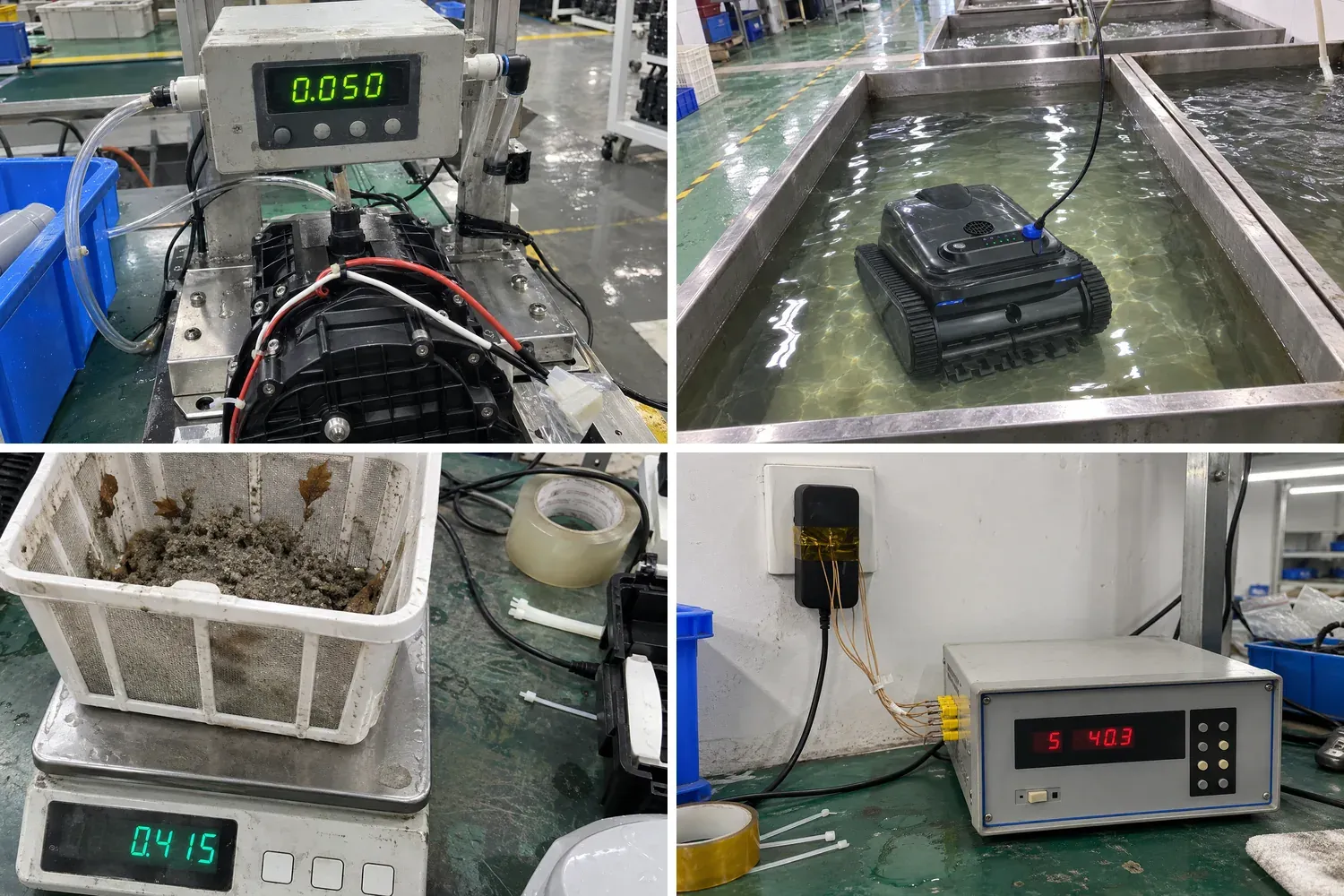
We pressurize the motor housing to 0.05 MPa, hold it, and watch the tester for any pressure drop. Then the housing goes into a tank of water and we look for bubbles. None of the three samples leaked. On the production line, every finished robot also runs in a water tank before it's packed, so sealing gets checked twice: once on the design, and once on every unit.
1,100 hours underwater
If we had to pick one test to show a buyer, it would be this one. We put 10 robots in water tanks on a DC supply and ran them 3 hours on, 1 hour off, for 1,100 hours, past our 1,000-hour target. No motor stalled, no track slipped and no unit had a software fault. By the end the tracks showed real wear, which is what 1,100 hours of crawling does, and every robot was still running.
Does it actually clean?
We used a 3 x 3 m tiled test pool, kept the water at around 10 °C, and put in 20 rotting leaves and 450 g of sand. After one hour, every leaf was gone and the basket held 415 g of sand, which is 92%. Our pass mark is 90%. Cold water and soggy leaves are harder than what most demo videos show, and that's exactly why we test that way.
Heat, cold and pool chemicals
The control boards ran for 8 hours at 70 °C and 90 to 95% humidity, then 8 hours at -20 °C, then went through 10 hot-cold shock cycles. Tracks and seals were cycled between 70 °C and -20 °C for a week. Then we took every plastic, silicone and rubber part and left them in a bleach and algaecide solution for a month. Nothing cracked, faded, peeled or changed shape.
Batteries and chargers
After that 2025 recall, this is the section we'd read most carefully. During discharge, the hottest battery cell reached 40 °C against a 67 °C limit. We taped thermocouples to the charger and logged it through five hours of charging. It never went above 41.6 °C, against a 60 °C limit. The charger also passed a 3.6 kV withstand test, and the firmware shuts the robot down on over-temperature and locks it out at low voltage.
Shipping and everyday handling
Packed robots spent an hour on a vibration table, 20 minutes on each axis, and went through drop tests to GB/T 2423.7 and IEC 60068-2-31. The color boxes came out a little dented. The robots inside powered on, charged and cleaned normally. We also pressed the power button 1,000 times. It takes at least 15 N to press, which helps prevent accidental switch-on. And we hung three times the robot's weight on the retrieval hook and shook it for a minute.
What we check on every unit
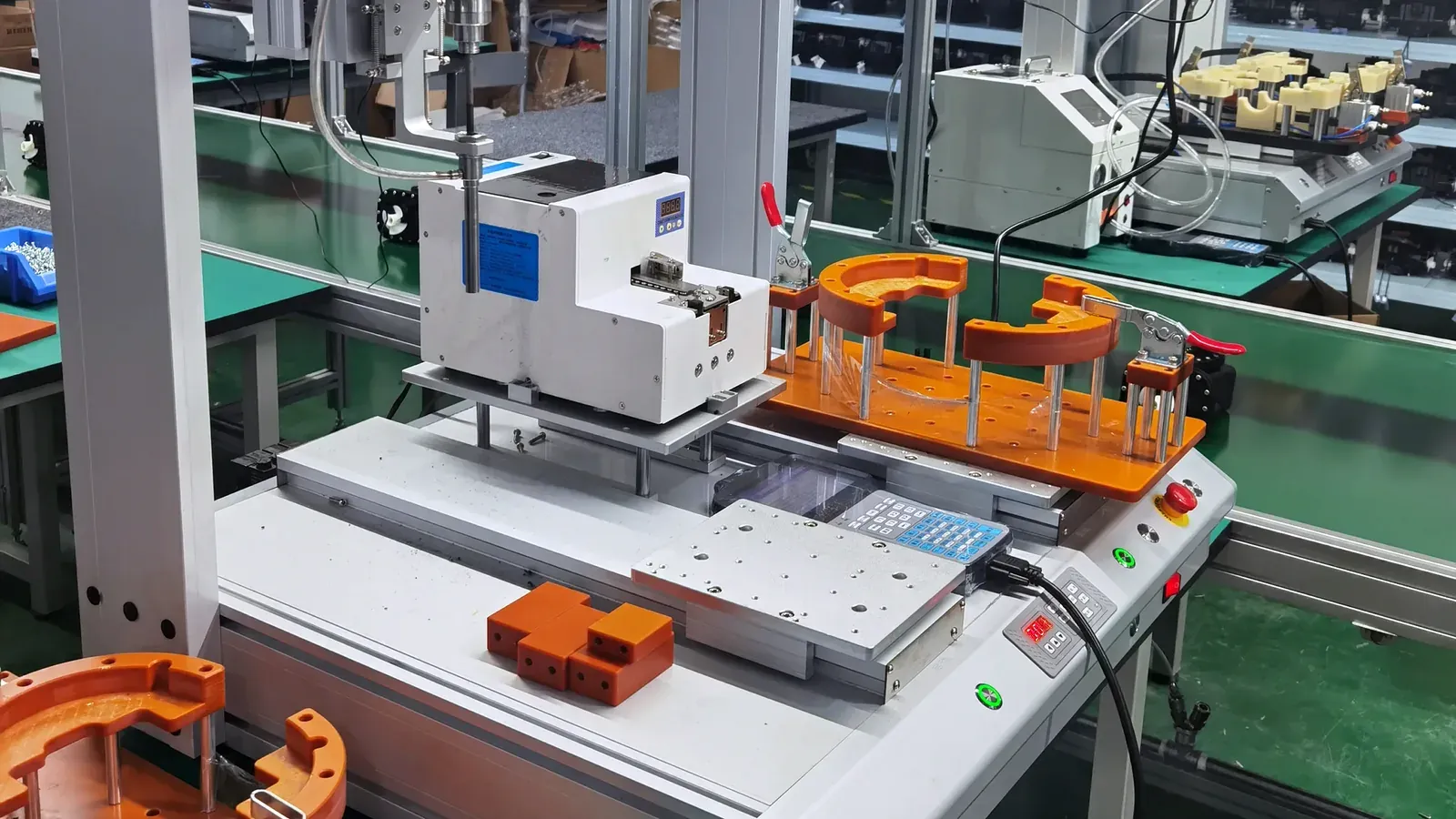
Validation proves the design. It doesn't prove the robot in carton number 4,812. That's the job of the production line in our own factory in Changzhou. Every robot runs in a water tank before packing, every unit gets a final inspection, and cosmetic checks follow the same standard we used in validation: part gaps and steps under 0.3 mm, and colors matched against approved samples. There's more on our Manufacturing & Quality page.
The paperwork you'll need
Your forwarder will ask for a UN38.3 test report and an MSDS before booking lithium-powered goods, and air freight adds dangerous-goods paperwork and labels on top. We supply the UN38.3 report and MSDS. Our factory, Changzhou FreeGo Robotics, holds ISO 9001, ISO 14001 and ISO 45001 and has passed an amfori BSCI audit by TÜV Rheinland. Market certifications such as CE or FCC depend on the model and where you sell, so check them model by model, with us or with any other supplier.
Questions we'd ask any supplier
If we were buying, these are the questions we'd send before the first sample order:
1. Which validation tests did this model pass, and what were the results?
2. How long was the life test, on how many units, and what wore out?
3. How is sealing checked, on the design and on every production unit?
4. What are the battery and charger temperature limits, and what did you measure?
5. Can you send the UN38.3 report and MSDS for this battery?
6. What happens on the line before a unit goes into the box?
7. Can I test samples in my own market before I order?
A supplier who answers with numbers, and tells you what wore out, has usually done the testing. One who answers with adjectives probably hasn't.
FAQ
Is every unit tested for 1,100 hours?
No. The life test runs on sample units before launch. Every production unit gets a water test and a final inspection before packing.
Can I see how you test?
Yes. Ask us about the test methods for the models you're looking at. If it helps, we can also send a short summary of the results.
What documents do I need to ship pool robots with lithium batteries?
Your forwarder will usually ask for a UN38.3 test report and an MSDS. For air freight, expect dangerous-goods paperwork and battery labels as well.
Planning a pool robot line for next season? Tell us your market and target price in the form below. We'll suggest models and walk you through how they were tested.
Written by the Silver Home R&D and quality team.