Oct 27, 2026采购指南
充电故障排查
充电器显示满电但机器人不启动,退货前先换已确认正常的充电器,再查触点、温度与冬季存放。

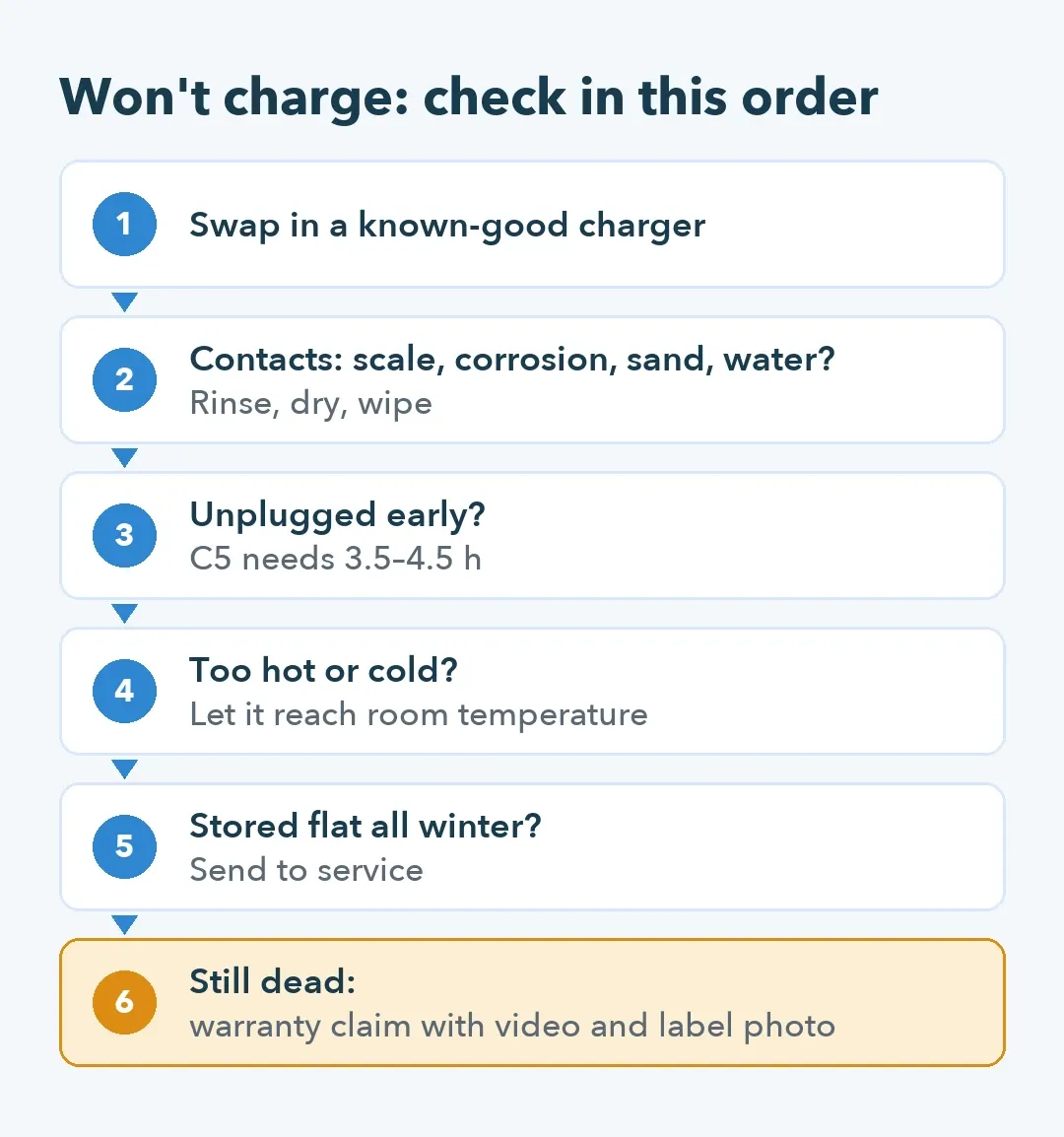
The charger light says full, the robot won't start, and a new battery changed nothing. That's a paraphrase of owner complaints posted on public review sites, and it points away from the battery: before anyone books a return, swap in a known-good charger.
Keep two known-good pool robot chargers at your service desk for this test alone.
Is it the charger?
Is the charger light on at all when it's plugged in? Is it the original charger for that pool robot model, or one borrowed from a drill or a laptop? A charger with the right plug can still have the wrong voltage or current for the battery. Run a finger along the cable for crush marks where it was coiled for winter. Then plug the robot into the desk charger. If it charges, post the owner a new charger and close the case.
White crust on the contacts
Pool water dries into scale, and charging contacts are where it shows: white crust, green corrosion, sand in the port, or water still sitting in the socket. Rinse the robot in fresh water and let it dry completely. Wipe the contacts with a dry cloth before you plug in. Never charge a wet robot. Under your own brand, that sentence belongs on the first page of the manual.
Was it unplugged too early?
Our C5 takes 3.5–4.5 hours to charge fully. An owner who unplugs after an hour gets a short run the next morning and reports a charging fault. Put each model's charge time in your support script, and ask how long the robot was plugged in before anything else.
Heat and cold block a charge
Lithium battery packs carry protection that can refuse a charge when the cells are too hot or too cold, and to an owner that looks like a fault. A pool robot lifted out after a long run in full sun, or stored in a freezing garage, can sit outside that window. Bring it indoors, leave it until it reaches room temperature, then try again.
The same protection works while the robot cleans. On our Y50S, the firmware shuts the robot down if it overheats and locks it out when the battery voltage drops too low; both were checked in its validation tests. Either one leaves a robot that won't run until it's cooled or charged.
It ran fine all last summer
A lithium battery drains slowly in storage. Put away nearly flat in autumn, it can fall low enough over winter that its protection blocks a normal charge, and the pool robot looks dead in spring. Don't let owners force it with a different charger; send these units to your service team. Prevention is one line in the manual: charge before storage and top up during a long winter, as the model's instructions say.
Your own warehouse has a winter too. Charge-test a few pool robots from stock that sat through it before the season opens.
When it becomes a warranty claim
A pool robot that still won't charge on a known-good charger, with clean dry contacts, after a full charge time at room temperature, is a warranty case. Our warranty is 1 year on the whole unit. Ask for a short video of the robot plugged in with its lights visible, plus a photo of the rating label. One more line for the script: a charger that's cracked, swollen, smells hot or has a damaged cable is retired on the spot, and the owner gets a replacement.
Each of our pool robot models has its own charging and storage instructions, and they make the first page of a good support script. Request them for the models you sell.
Written by the Silver Home R&D and quality team.